The Chirpan earthquake was a series of seismic tremors between April 14 and 25, 1928 near Chirpan, Popovitsa and Galabovo in the Marish seismic region in southern Bulgaria. The strongest of the quakes occurred on April 18 and had a magnitude of 7.0 on the Richter scale. After the first earthquake, almost all the buildings in Chirpan and Borisovgrad (now Parvomai) were destroyed. Seven thousand families were left without a roof, railway lines were deformed, the flow rate of wells and springs was changed, the Merichler mineral spring disappeared for a while. The second earthquake destroyed nearly a third of the city of Plovdiv. The series of earthquakes affected one seventh of the territory of Bulgaria with a population of over 400 thousand people. The victims are 107 people, 500 people are injured. The earthquakes cause a total of damages worth about BGN 3.3 billion. Over 72,000 buildings were affected, and about 26,000 of them were destroyed.
What is an earthquake
You feel the ground begin to shake and the objects around shake. There's an earthquake. Also called an earthquake, it is caused by the movement of parts of the earth's crust - its outermost layer. It often happens that several tremors are felt one after the other until the earth's layers settle down. The occurrence of earthquakes cannot be predicted or prevented.
What is earthquake magnitude
Magnitude characterizes the intensity of earthquakes – the larger it is, the more destructive the earthquake.
Magnitude is most often determined by a scale created by the American scientist Charles Richter and called the "Richter scale". An earthquake with a magnitude of 3 to 4.9 on the Richter scale is considered mild; 5 to 6.9 is moderate to severe; from 7 to 7.9 is significant; 8 or more is extremely powerful.
What is a seismograph?
A seismograph is a device used to record seismic waves. The record that the seismograph registers is called a seismogram.
Before an earthquake
- Prepare an emergency kit (disaster backpack) containing a first aid kit, a flashlight, a cell phone charger, a radio, food, and water for 72 hours.
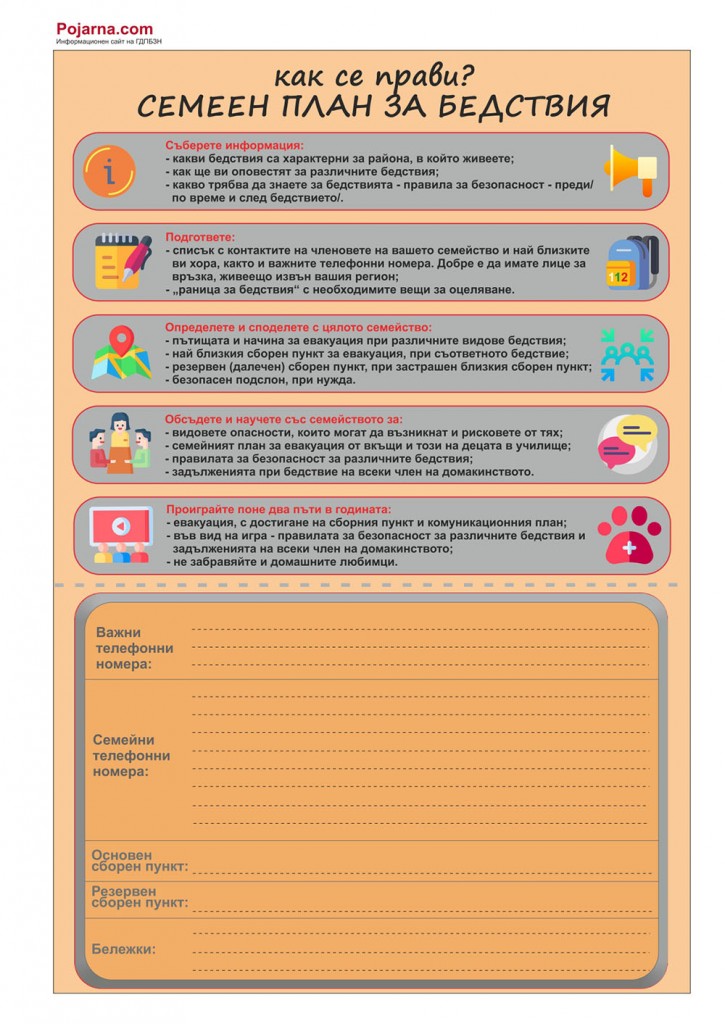
- It is advisable to plan in advance what your family and loved ones will do. Make a family disaster plan. Identify a safe place to meet your family, as well as evacuation routes and methods. Write down the phone numbers of your closest relatives.
- Check for heavy objects that could fall or break during an earthquake and move them to safer locations.
- Talk to your family about the safest places in the home in the event of an earthquake. This could be under a sturdy table or next to an interior wall, away from windows.
During an earthquake
- Stay calm and don't panic.
- Cover your head and neck with your hands.
- Crawl under a sturdy table/desk to protect yourself from falling objects or stand next to an interior wall (away from windows).
- If you are outdoors, stay away from buildings, poles, tall trees, and power lines.
- If you are on public transportation, it is better to wait for the shaking to stop while inside the vehicle.
- Aftershocks often follow the initial earthquake. Be prepared to react.
- When leaving your home, turn off the gas, water, and electricity. Do not use the elevator.
- Beware of broken glass and debris.
- Check yourself and the people around you for injuries.
- Stay away from the beach. Coastal areas may be exposed to a tsunami or a series of dangerous waves.
- If you are trapped under debris, cover your nose and mouth with a piece of clothing or a cloth to protect your airways from dust. Periodically tap on a pipe or wall to help rescue teams locate you.
- If you need help, call 112.
After Earthquake
- Stay away from the affected areas. Before returning home, make sure it is safe to do so. The building's structure may be damaged. Check for any sagging or warping of the walls or floors. Only return if it is safe to do so.
- Check back for up-to-date information. Important information sources are the national radio and television channels.
- Follow the instructions of the competent government structures - fire department, police, health authorities and others.
- Observe personal hygiene. Do not drink water from untested sources.






CONTACTS
GENERAL DIRECTORATE "FIRE SAFETY AND PROTECTION OF THE POPULATION"
Sofia 1309, 171A Pirotska Str.
Email: nspab@mvr.bg
Tel.: 02 982 12 43


Sofia 1309, 171A Pirotska Str.
Email: nspab@mvr.bg
Tel.: 02 982 12 43