
From the story: On March 4, 1942, in the city of Vidin, more than 5,000 houses were flooded, and 500 of them were completely destroyed. The winter is hard and the Danube River freezes. During the first days of spring, huge blocks of ice pile up on the bend near Bogdan Island, at night the waters stop flowing, carry away the dykes and flood the city. The wave reaches 5 meters, and the river spills over to the surrounding villages of Vidbol and Smerdan. The victims of this flood were only 13, and thousands were evacuated. Aviation bombards the ice dam next to Bogdan Island and unclogs the river. The water begins to slowly drain away, but recedes completely four months later - in early June.
Flooding means the temporary covering by water of land areas not normally covered by water, including from rivers, mountain streams and sea-induced flooding of coastal areas.
Losses due to flooding
Floods cause huge losses as they affect populated areas, industrial areas and productive agricultural lands. They are increasing in frequency and intensity, as are those of extreme precipitation due to climate change. According to a UN report, floods are the most common of all disasters - 44%, and for the period 2000-2019, they affected 1.65 billion people and caused more than 650 billion dollars in damages. According to data from the National Statistical Institute, for the period 2010-2020, 3,533 floods occurred in our country.
In the event of imminent danger of flooding
Keep an eye on the weather forecast. Check for up-to-date information from the relevant authorities. Important information sources are the national radio and television channels. In addition to them, you can also receive a warning of danger through the National Early Warning and Disclosure System. It's the same system we hear every year on June 2nd and when it's tested on the first business day of April and October. Through BG-ALERT, which is an addition to the existing National system, it is possible to distribute messages through the networks of mobile operators to end devices, such as mobile phones, tablets and smart watches, supporting the Cell Broadcast Service technology.
Before a flood
To learn more about the risk of flooding, you can seek information from the municipality, as well as on the websites of the River Basin Directorates of the Ministry of Environment and Water.
Find out how you can insure your property against disasters.
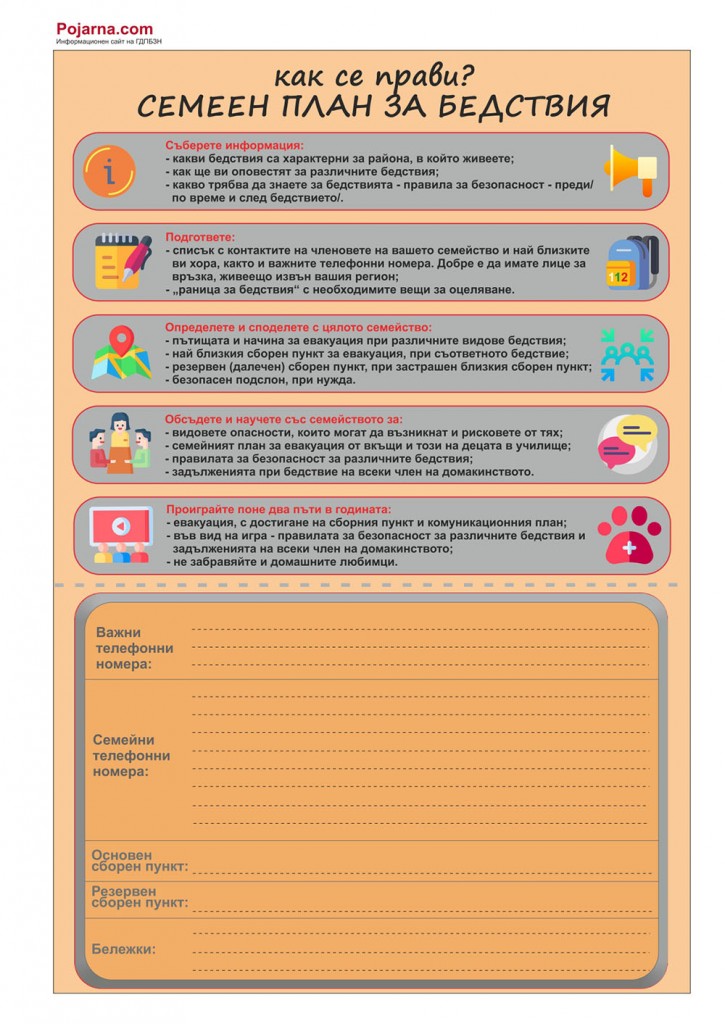
It is advisable to plan in advance what your family and loved ones will do. Make a family disaster plan. Identify a safe place to meet your family, as well as evacuation routes and methods. Write down the phone numbers of your closest relatives.
Prepare an emergency backpack with the most important items for survival (first aid kit, flashlight, cell phone charger, radio, food, and water for 72 hours).
During a flood
If you are at home, turn off the gas and electricity. This will protect you from possible electric shock.
Place all the more valuable items and possessions as high as possible. That way, you'll have a better chance of keeping them.
If it is impossible to take animals and pets with you, open the doors of the rooms where they are closed. That way they will have a better chance of survival.
Grab the disaster backpack and leave your home as quickly as possible following the family disaster plan. If it is impossible to leave the building due to the incoming water, move to the upper floors or, as a last resort, to the roof and signal for help, including by calling 112.
If you are near a river or in a ravine, move away immediately and move to higher ground. You should never stand under/on bridges, underpasses, overpasses and other potentially flooded areas.
Never cross fast-flowing water. In emergency situations, with the help of a safety rope, you can cross calm water, checking the depth and the terrain for hazards. If you are in a car, make sure the water level is lower than the axles of the car and then cross.
Stay tuned to radio and television for up-to-date information from the competent authorities. If necessary, call 112 for help and instructions.
After a flood
Before returning home, make sure it is safe to do so. If the power supply was not turned off before the flood, you could be injured by the electrical system. Appliances that have gotten wet can cause electric shock or fire when they are turned on. The building's structure may also be damaged. Check for any sagging or warping of the walls or floors.
Floodwater may be contaminated with sewage and other pollutants. It can cause illnesses and infections. If the color, smell, or taste of the water you are drinking leads you to suspect that it is contaminated, do not consume it. Use bottled water or water supplied by the competent authorities.
Do not consume meat from injured or drowned animals or food with damaged packaging.








CONTACTS
GENERAL DIRECTORATE "FIRE SAFETY AND PROTECTION OF THE POPULATION"
Sofia 1309, 171A Pirotska Str.
Email: nspab@mvr.bg
Tel.: 02 982 12 43


Sofia 1309, 171A Pirotska Str.
Email: nspab@mvr.bg
Tel.: 02 982 12 43