
Did you know that on Christmas Eve, at least 20 Bulgarian families experience the horror of seeing their homes go up in flames? The largest number of residential fires are reported during the heating season, which is also when 95% of fatal fire incidents occur.
Fire safety rules
- If a fire breaks out, stay calm – panic will prevent you from acting correctly.
- Try to extinguish the fire. If you have a fire extinguisher at hand, know how to use it, and feel confident in your actions, don't hesitate to use it. Do not use water to extinguish live electrical appliances or grease fires!
- If the fire is large, you cannot extinguish it, or it threatens your life and health, leave the dwelling. Close the doors behind you – this will limit the rapid spread of the fire. Do not jump out of windows/balconies, do not climb down downspouts, and do not use the elevator.
- Remember that you have about 2 minutes to get out of the burning building. If you are unable to evacuate, use wet clothes/towels to seal the area around the door of the room you are in. Leave some kind of sign on the window or balcony to indicate where you are so that the firefighters can find you more easily. Call 112 and give your exact location.
- Just a few breaths of smoke can cause you to lose consciousness, and this can be fatal. If you have to pass through smoky areas, always move low to the floor, as smoke rises. Cover your mouth and nose with a wet piece of clothing/cloth.
- If your clothes catch fire, do not run – this will cause the fire to spread faster. Instead, stop, lie down on the ground, cover your face with your hands, and roll until the fire goes out.
- Once you have left the dwelling, do not go back.
If you have information about people in danger or about the presence of substances/materials that could cause a fire to spread rapidly or cause an explosion, notify the fire department immediately!
How can we reduce the risk of a fire?
In the kitchen
- Keep the burners and the oven clean. Food that has not been cleaned off can easily catch fire and cause a fire.
- Clean the range hoods and ducts regularly.
- Keep kitchen towels and sponges away from the stove and other hot surfaces.
- Only plug kitchen and household appliances into properly functioning and grounded outlets.
- Unplug the toaster and other appliances when not in use.
- Do not use the oven or stove for heating.
- Do not cook if you are feeling sleepy, have consumed alcohol, or have taken medication that causes drowsiness.
- When cooking, turn the handles of cookware away from the burners to avoid burns and spills.
- Do not leave the kitchen while cooking. Turn off the stove if you leave, even if it's just for a short time. If you are boiling or baking food, check it frequently. Use a timer to remind you that you're cooking.
- Wear short-sleeved clothing, and if it has long sleeves, make sure they are tight-fitting or rolled up. Loose-fitting clothing can easily catch fire when it comes into contact with the flame from gas stoves.
- Once you have finished cooking, make sure that the stove and other electrical appliances are turned off.
Electrical installation
- Replace the electrical fuses with fusible links with automatic ones. They are more reliable and can be used repeatedly. When replacing fuses, check that they have the correct amperage.
- Check that all electrical circuits are correctly labeled on the panel.
- Once a month, check all fuses and circuit breakers to make sure they are working properly.
- Regularly check cables, sockets, plugs, and electrical appliances for damage. If there are any, do not use them until they have been repaired.
- Use only sockets that are in good working order and grounded. Do not overload them with too many devices and electrical appliances. Install outlets with ground fault circuit interrupter protection if they are located near water (wet rooms, bathrooms) to protect yourself from electric shock.
- Avoid using power strips. Never plug electrical appliances such as water heaters or stoves into them.
- Do not run cables under carpets or rugs, and do not pinch them with furniture, doors, or windows.
- If you notice frequent problems with fuses blowing or tripping, flickering or dim lighting, or outlets or switches that make crackling, buzzing, or popping sounds, call a professional to check the electrical system.
Heating with electrical appliances
- Use only standard and technically sound heating appliances. Follow the manufacturer's operating instructions.
- Only connect electrical appliances to circuits with wires of a suitable cross-section. If possible, plug the appliances directly into the wall outlet and not through power strips.
- Do not use heating appliances with exposed heating elements.
- Never leave flammable objects on or near electrical appliances. Do not use them to dry clothes.
- Never leave children unattended when electrical appliances are switched on.
- When leaving the house, make sure you have turned off all appliances. Never leave appliances unattended when they are switched on.
- Secure all heating appliances well due to the risk of tipping over.
- Appliances connected to the electrical grid must not be extinguished with water in the event of a fire! This can only be done after disconnecting the power supply from the electrical panel!
Heating with solid/liquid fuel appliances
- Use only standard and technically sound heating appliances. Follow the manufacturer's operating instructions.
- Heating appliances must be placed at a distance of no less than 1 meter from combustible objects. Do not use the appliances to dry clothes.
- Heating appliances must be installed on a non-combustible base with thresholds on all sides measuring 30 cm at the front and 20 cm on either side of the appliance. The wall behind the stove must be lined with non-combustible materials.
- Solid fuel stoves must never be lit with flammable liquids (gasoline, diesel, etc.). Clean the stove's combustion chamber regularly. Never dispose of ash and coals (embers), or combustible waste, in plastic containers for household waste.
- Store liquid fuel in designated safe places outside residential areas.
- Ventilate heated rooms regularly. Install carbon monoxide/dioxide detectors to warn you when levels reach values that are hazardous to health.
- Chimneys must be well plastered, without cracks. They must be periodically cleaned of accumulated soot. It is not allowed to connect air ducts from ventilation systems to them.
- Make sure that the flue pipes (chimneys) are properly installed and stable.
- The openings to the chimney must be closed with standard sheet metal (metal) covers.
Heating with gas appliances
- Propane-butane is very often used in households for domestic purposes. It is heavier than air and, if it leaks, it accumulates in the lower part of rooms. For this reason, it should never be stored or used in underground spaces.
- If you use propane-butane gas appliances for heating, it is extremely important to ventilate the rooms regularly. Install carbon monoxide/dioxide detectors to warn you when levels reach values that are hazardous to health.
- Household cylinders are filled only at locations where propane-butane cylinder filling stations have been established. The amount of gas must not exceed 80% of the cylinder's capacity. Overfilling the cylinder, combined with an increase in ambient temperature, can lead to an increase in pressure inside the cylinder, gas leakage, and the risk of explosion. A gas leak may also occur if the pressure reducing valve, the diaphragm, or the rubber seal of the cylinder are defective.
- Flexible connection hoses must be free of cracks and up to 1.5 m long. They must not be kinked or missing their tightening clamps.
- Follow the manufacturer's instructions for carrying out periodic technical inspections of the cylinders.
- Do not store propane-butane cylinders near heat sources – stoves, chimneys, cooktops, or in direct sunlight. Protect from impact, do not roll them or leave them lying down.
- Do not leave gas appliances unattended while they are in operation.
- If you suspect a propane-butane leak (it smells like garlic), close the cylinder valve, open windows/doors to ventilate the room (if possible, take the leaking cylinder outside); do not use ignition sources and do not switch electrical appliances or lights on/off – any flame or spark (even from static electricity) can cause an explosion.
Pyrotechnic articles
- When buying pyrotechnic articles, make sure that their quality and origin are guaranteed.
- Follow the manufacturer's instructions for safe use.
- Familiarize yourself with the intended use and hazard level of the products.
- Keep pyrotechnic articles away from sources of heat.
- Use pyrotechnic articles outdoors and away from flammable substances and materials.
- Do not allow children to play with pyrotechnic articles. Keep them out of their reach.
Candles and cigarettes
- Do not leave burning candles unattended. Extinguish them when you leave or go to bed.
- Use non-flammable, stable holders. Burning candles should not be placed under shelves, on ledges, or near curtains. Place them at a safe distance from flammable objects and materials.
- When lighting a candle, be careful with your hair and clothing.
- Keep burning candles away from small children and pets. Their actions can cause a fire.
- Avoid smoking in bed. Make sure you extinguish the cigarette butt before disposing of it.
During holidays
- Use only standard and properly functioning lights and decorations.
- Place decorations at a safe distance from heating appliances.
- When you leave your home or go to bed, unplug the lights.
- Always exercise caution when using heating appliances, candles, cigarettes, and fireworks. Be even more careful if you are under the influence of alcohol – alcohol slows down your reactions and makes you careless.
Additional tips:
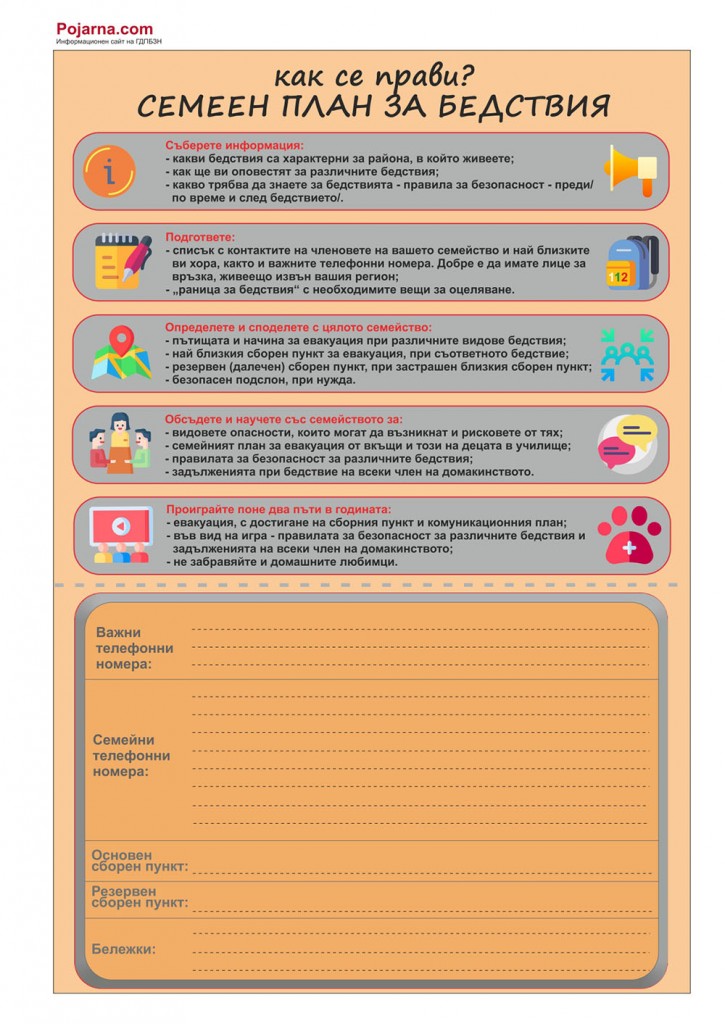
- Make an evacuation plan that includes a route for safely leaving your home in the event of a fire. Assume that this route is the daily path for entering and exiting. Also identify an alternate route in case the first one is blocked. Make sure every member of the family learns the evacuation route. Practice the route with your family at least twice a year.
- Prepare an emergency backpack with the most important items for survival (first aid kit, flashlight, cell phone charger, radio, food, and water for 72 hours).
- Keep the door keys in a place where everyone can find them, or simply leave them in the locks. Do not lock children in when leaving them alone at home.
- Teach children that lighters and matches are not toys. Keep them out of their reach.
Place a fire extinguisher in your home and learn how to use it.





Measures for the safe use of electrical appliances
Fire safety measures in the kitchen
Fire safety measures during the holidays

CONTACTS
GENERAL DIRECTORATE "FIRE SAFETY AND PROTECTION OF THE POPULATION"
Sofia 1309, 171A Pirotska Str.
Email: nspab@mvr.bg
Tel.: 02 982 12 43


Sofia 1309, 171A Pirotska Str.
Email: nspab@mvr.bg
Tel.: 02 982 12 43